CSS
:Eample of Css
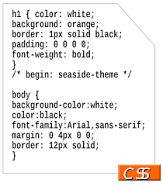

CSS: Cascading Style Sheets (CSS) is a style sheet language used for describing the presentation of a document written in a markup language like HTML. CSS is a cornerstone technology of the World Wide Web, alongside HTML and JavaScript.
:The basics of css
:Syntax
CSS has a simple syntax and uses a number of English keywords to specify the names of various style properties.
A style sheet consists of a list of rules. Each rule or rule-set consists of one or more selectors, and a declaration block.
:Selector
In CSS, selectors declare which part of the markup a style applies to by matching tags and attributes in the markup itself.
Selectors may apply to the following:
- all elements of a specific type, e.g. the second-level headers h2
- elements specified by attribute, in particular:
- id: an identifier unique within the document
- class: an identifier that can annotate multiple elements in a document
- elements depending on how they are placed relative to others in the document tree.
Classes and IDs are case-sensitive, start with letters, and can include alphanumeric characters, hyphens and underscores. A class may apply to any number of instances of any elements. An ID may only be applied to a single element.
Pseudo-classes are used in CSS selectors to permit formatting based on information that is not contained in the document tree. One example of a widely used pseudo-class is :hover, which identifies content only when the user “points to” the visible element, usually by holding the mouse cursor over it. It is appended to a selector as in a:hover or #elementid:hover. A pseudo-class classifies document elements, such as :link or :visited, whereas a pseudo-element makes a selection that may consist of partial elements, such as ::first-line or ::first-letter.[6]
Selectors may be combined in many ways to achieve great specificity and flexibility.[7] Multiple selectors may be joined in a spaced list to specify elements by location, element type, id, class, or any combination thereof. The order of the selectors is important. For example, div .myClass {color: red;} applies to all elements of class myClass that are inside div elements, whereas .myClass div {color: red;} applies to all div elements that are in elements of class myClass.
The following table provides a summary of selector syntax indicating usage and the version of CSS that introduced it
:Coding time

 Active Lessons